What Is Crane Span and How to Calculate It?
(Complete Guide for Overhead Crane Design & Selection)
When selecting or designing an overhead crane, one of the most critical parameters is crane span. Getting it wrong can lead to installation issues, unsafe operation, and unnecessary costs.
In this guide, you’ll learn exactly what crane span is, how to calculate it, and how it affects crane pricing and performance.
What Is Crane Span?
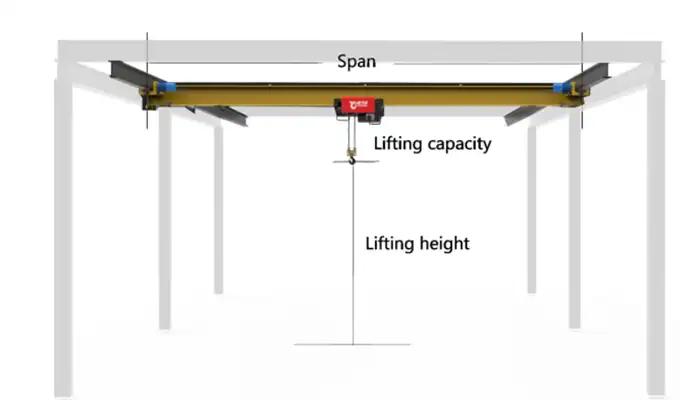
Definition:
Crane span is the horizontal distance between the centers of the two runway rails on which the crane travels.
In simple terms:
It is the width of the area the crane needs to cover
Why Crane Span Matters
Crane span directly affects:
-
Structural design (girder strength)
-
Crane cost (more steel = higher price)
-
Performance & stability
-
Workshop coverage area
Key Insight:
The larger the span → the stronger (and more expensive) the crane must be.
How to Calculate Crane Span
Standard Formula:
Crane span = Distance between runway rail centersPractical Calculation Method:
-
Measure the distance between building columns
-
Identify the center line of each runway rail
-
Calculate the distance between these two center lines
That value = crane span
Example:
-
Distance between rails = 20 meters
Crane span = 20m
Span vs Workshop Width (Important Difference)
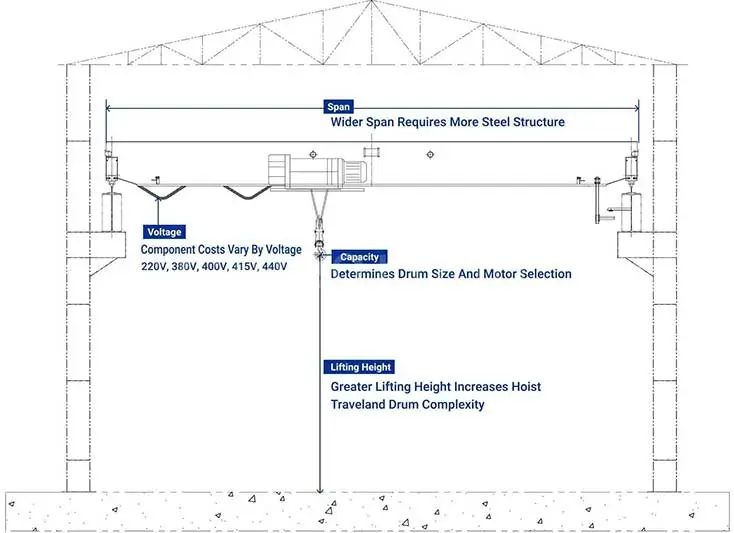
Many beginners confuse these two.
Wrong:
Workshop width = crane span
Correct:
Crane span = distance between rails (not walls)
Usually:
-
Crane span is slightly smaller than building width
Standard Crane Span Ranges
| Crane Type | Typical Span |
|---|---|
| Single Girder Crane | 7.5m – 30m |
| Double Girder Crane | 10m – 40m+ |
| European Type Crane | Up to 35m |
Custom spans are possible, but cost increases significantly.
How Span Affects Crane Cost
Cost Impact:
-
Larger span → more steel → higher cost
-
Stronger girder required
-
Higher transportation and installation cost
Rule of thumb:
Increasing span by 10% can increase cost by 15%–25%
Common Mistakes When Calculating Span
Measuring wall-to-wall instead of rail-to-rail
Ignoring runway beam position
Not considering installation clearance
Choosing oversized span (wastes money)
Pro Tips for Accurate Span Selection
Tip 1: Always Use Rail Center Distance
This is the industry standard
Tip 2: Work with Layout Drawings
-
Use CAD or workshop drawings
-
Confirm with supplier before production
Tip 3: Consider Future Expansion
-
Leave room for extension if needed
Tip 4: Consult Crane Supplier Early
They can optimize:
-
Span
-
Load distribution
-
Cost efficiency
Real Case Example
Factory Scenario:
-
Workshop width: 22m
-
Rail center distance: 20m
Final crane span: 20m
Saves cost
Ensures proper installation