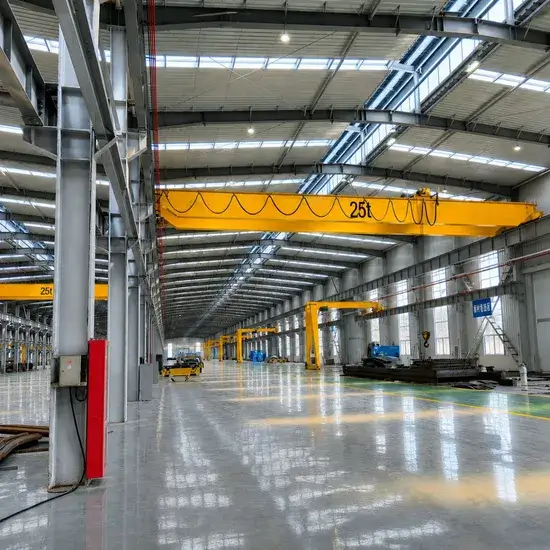
Common Overhead Crane Problems & Solutions | Professional Guide
Overhead cranes are essential for material handling in industries like manufacturing, metallurgy, ports, and warehousing. However, as frequently used heavy equipment, they inevitably develop various faults over time. Statistics show that over 60% of crane accidents are directly related to equipment failure. This article provides a systematic guide to common overhead crane problems and their professional solutions, covering mechanical, electrical, and structural issues.
1. Hoist Mechanism Failures & Solutions
1.1 Brake Failure – "Load Drifting"
Symptoms: The load drifts downward after braking, or the crane drifts after stopping.
Root Cause Analysis:
| Cause | Description |
|---|---|
| Oil contamination on brake wheel | Reduced friction coefficient, lower braking torque |
| Worn brake lining | Rivets exposed, contacting the brake wheel |
| Improper main spring adjustment or fatigue | Insufficient spring tension |
| Misaligned brake unit | Brake bracket not concentric with brake wheel |
| Hydraulic thruster impeller obstruction | Reduced braking torque |
Solutions:
-
Cleaning: Remove oil contamination from the brake wheel surface using kerosene or gasoline.
-
Replace Worn Parts: Immediately replace severely worn brake linings to prevent rivets from scoring the brake wheel.
-
Adjust/Replace Springs: Readjust main spring tension. Replace any spring showing fatigue or cracks.
-
Correct Alignment: Loosen the brake bracket anchor bolts, clamp the brake shoes onto the wheel, fill any gaps, then retighten.
-
Inspect Hydraulic System: Check the hydraulic thruster impeller and remove any obstructions.
Critical Note: The brake is the single most important safety device on an overhead crane. A brake test must be performed daily before operation.
1.2 Wire Rope Failure
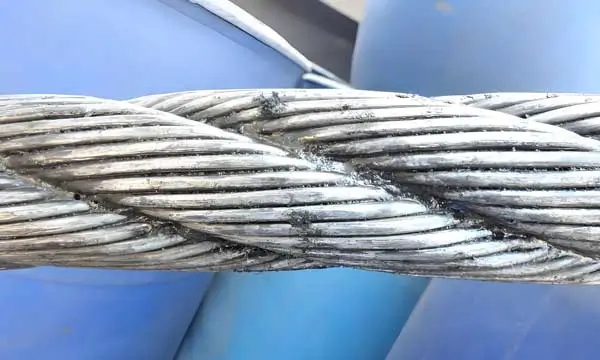
Symptoms: Broken wires, abrasion, kinking, "birdcaging," or dislodging from grooves.
Solutions:
-
Regular Lubrication: Maintain a thin oil film on the wire rope surface.
-
Monitor Broken Wires: If broken wires exceed 10% of total wires within one lay length, the rope must be replaced.
-
Prevent Dislodging: Check wire rope winding on drums and sheaves. Ensure hold-down bolts are tight and have locking devices.
1.3 Hook Failure
Symptoms: Hook tilts, rotates poorly, or the hook block separates.
Solutions:
-
Replace Thrust Bearing: If the hook rotates poorly, replace the thrust bearing.
-
Repair Limit Switch: Hook block separation often indicates a failed upper limit switch. Repair immediately.
-
Strictly Avoid Overloading: Overloading is a primary cause of hook fracture. Always adhere to rated capacity.
2. Travel Mechanism Failures
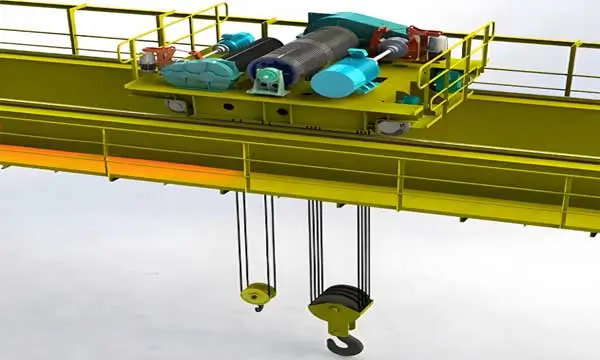
2.1 Crane "Wheel Climb" / Rail Gnawing
Symptoms: Severe friction between wheel flanges and rail sides, sharp squealing noises, and visible wear marks on the rail side.
Root Cause Analysis:
-
Inaccurate wheel installation (excessive vertical/horizontal deviation)
-
Rail installation errors (elevation difference, span deviation, poor straightness)
-
Asynchronous drive system (excessive keyway clearance, worn gear couplings)
-
Bridge distortion or excessive diagonal difference
Solutions:
-
Inspect Drive System: Check drive shaft key connections and gear coupling engagement. Eliminate excessive clearance.
-
Adjust Wheels: Correct wheel alignment. Remachine wheel treads if necessary.
-
Repair Rails: Adjust rail elevation and straightness. Tighten rail clip bolts.
Professional Alert: Rail gnawing accelerates wear on both wheels and rails. In severe cases, it can cause the crane to derail and fall. Stop operation immediately if rail gnawing is detected.
2.2 Trolley "Slippage"
Symptoms: Drive wheels spin without moving the trolley.
Solutions:
-
Adjust wheel axle heights to increase drive wheel pressure.
-
Correct rail elevation differences.
-
Remove oil, ice, or other contaminants from the rail surface.
3. Electrical Control System Failures
3.1 Main Contactor Fails to Close
Symptoms: The main contactor does not activate after power is supplied; the crane will not start.
Troubleshooting Sequence:
-
Check if the supply voltage is normal.
-
Check for blown fuses.
-
Verify the controller handle is in the zero position.
-
Check if emergency stops and interlock contacts are closed.
-
Check for a burnt-out main contactor coil.
3.2 Controller Malfunction & Contact Failure
Symptoms: Sticking controller, inaccurate speed positions, or burnt contacts.
Root Cause Analysis:
-
Worn cam controller positioning ratchet, causing inaccurate detents.
-
Burned or eroded contacts from prolonged use.
Solutions:
-
Replace the worn positioning ratchet.
-
Replace burned contacts.
-
Critical Warning: Inaccurate positioning can cause two drive motors to run asynchronously, overloading one motor and potentially burning it out. Repair immediately – do not "make do."
3.3 Motor Overheating or Vibration
Symptoms: Excessive motor temperature during operation or abnormal vibration.
Root Cause Analysis:
-
Excessive start/stop frequency (exceeding the motor's duty cycle rating).
-
Overloading.
-
Damaged bearings.
Solutions:
-
Reduce the start/stop frequency.
-
Reduce the load or replace the motor with one matching the actual duty cycle.
-
Replace damaged bearings.
3.4 Control Signal Delay (Case Study)
Case: An overhead crane's main hoist exhibited a 1-2 minute start delay. Investigation revealed a faulty DC bus charging circuit in the VFD, causing an extended voltage ramp-up time.
Troubleshooting Approach:
-
Isolate the issue (local vs. remote control).
-
Check PLC input/output signal timing.
-
Check VFD fault codes.
-
Measure DC bus voltage rise time.
4. Gearbox & Coupling Failures
4.1 Abnormal Vibration & Noise in Gearbox
Symptoms: Cyclic vibration and "clunking" noises.
Solutions:
-
Replace damaged gears.
-
Check and tighten anchor bolts.
-
Align the motor shaft and gearbox input shaft concentrically.
-
Reinforce support structures to increase rigidity.
4.2 Coupling Issues
Inspection Points:
-
Keys and keyways should be undamaged and tight.
-
Axial shaft movement between couplings should be between 2-7mm.
-
Seal cover set screws should not be loose.
5. Metal Structure Failures
5.1 Bridge Distortion
Forms: Main beam sag, lateral bowing, excessive diagonal difference.
Prevention Measures:
-
Strictly avoid overloading.
-
Avoid frequent emergency stops and reversals.
-
Regularly perform static deflection tests on the main beam.
6. Preventive Maintenance System
6.1 Three-Tier Maintenance Schedule
| Frequency | Key Activities | Responsible Party |
|---|---|---|
| Daily / Pre-shift | Visual inspection, no-load function test, limit switch verification | Operator |
| Weekly | Brake fasteners, wire rope condition, coupling screws, safety device function | Maintenance Technician |
| Monthly | Brake lining wear, wire rope broken wires, hook NDT, gearbox oil level, wheel/rail wear | Professional Engineer |
6.2 Annual Mandatory Inspection
According to international standards (OSHA, ASME B30) and local regulations, overhead cranes require a comprehensive annual inspection by a qualified third party, including:
-
Load Test: Static and dynamic testing at 100% or 125% of rated capacity.
-
Non-Destructive Testing (NDT): Magnetic particle inspection of hooks and shafts.
-
Brake Performance Testing.
-
Rail & Wheel Alignment Measurement.
6.3 Record Keeping
All maintenance and inspection records should be archived to form a crane health history. This is not only a regulatory requirement but also essential for predicting failure trends and optimizing spare parts inventory.
7. Conclusion
The core principle of overhead crane fault management is "prevention over repair."
| Principle | Action |
|---|---|
| Zero Tolerance | Immediately stop operation if safety-critical components (brakes, limit switches, wire rope) show anomalies. Do not operate a faulty crane. |
| Data-Driven | Maintain operation logs and failure records. Use data analysis for predictive maintenance. |
| Professional Priority | Tasks involving electrical adjustment, brake tuning, and NDT must be performed by certified professionals. |
Establishing a complete maintenance cycle of "daily checks + periodic maintenance + annual inspections" can reduce unplanned downtime by over 30% and minimize the risk of safety incidents.